

Poignant, thought-provoking, memorable – the final ACCESS Leadership College Retreat
Published on 7 May 2026
Last month ACCESS held the last ever Leadership College Retreat at Dartington Trust in Devon. Here, four of the Leadership College Fellows – Richard Bridge, Helen Roberts, Susann Power and Jennifer Rudd, share their personal highlights from this memorable final get together.

Richard Bridge, Head of Monitoring and Evaluation on Defra’s Nature for Climate Tree Programme describes the conversations, field trips and reflections that this year’s retreat brought:
The last few days have been memorable. The final year of the ACCESS Leadership College, with an extra topping of work on Tuesday and Wednesday with a very special cohort on ‘what’s next’.
The Leadership College this year was even more special. Some highlights for me were keynote speaker Najma Mohamed talking to us about growing up in apartheid South Africa, an African philosophy of Ubuntu (which perhaps more than any other talk over the last 4 years chimed with me) and how her work adopts an interdisciplinary and intersectional approach that promotes green and sustainable roots, embedded in a struggle for social justice.
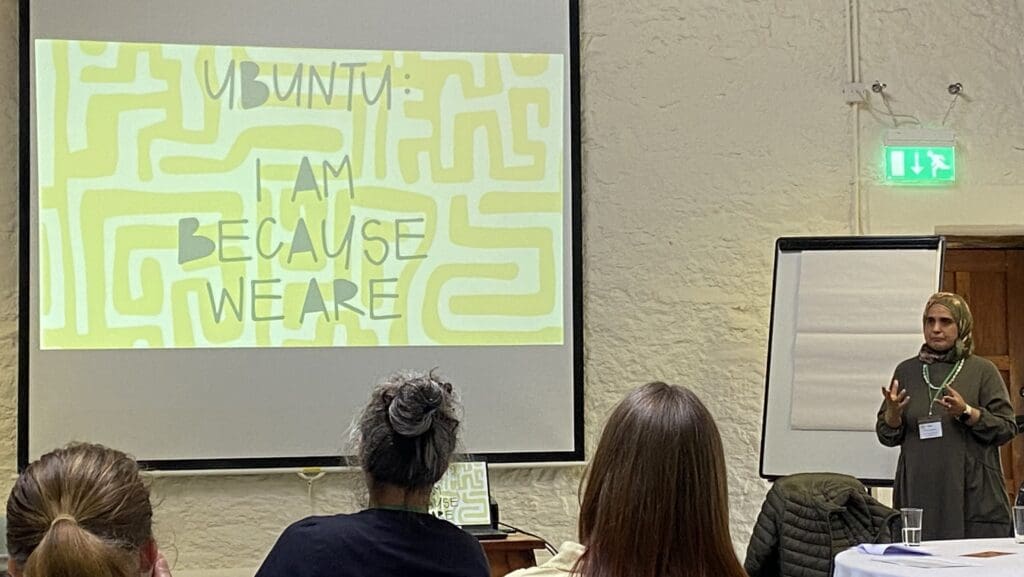
Dr Najma Mohamed’s keynote on Ubuntu
Next day we were shown the extensive storm damage inflicted on Torcross by Gail Stubbs – how the village is gradually crumbling into the sea and in her lifetime it has transformed from large swathes of beach to now almost disappearing (it has lost nearly 2 metres in height). And then I won’t forget talking to Najma about the very real links between South Africa and Palestine as we walked over to Slapton.
On our way over to Slapton Ley Field Centre we were treated to a thought-provoking talk about marine citizenship from Pamela Buchan and when we arrived Andre Kpodonu from Seeding Reparations gave a very stimulating – not to say challenging – reflection around organicism and fascism in the UK. Highly recommend you read more around anti-fascist approaches to food and farming.
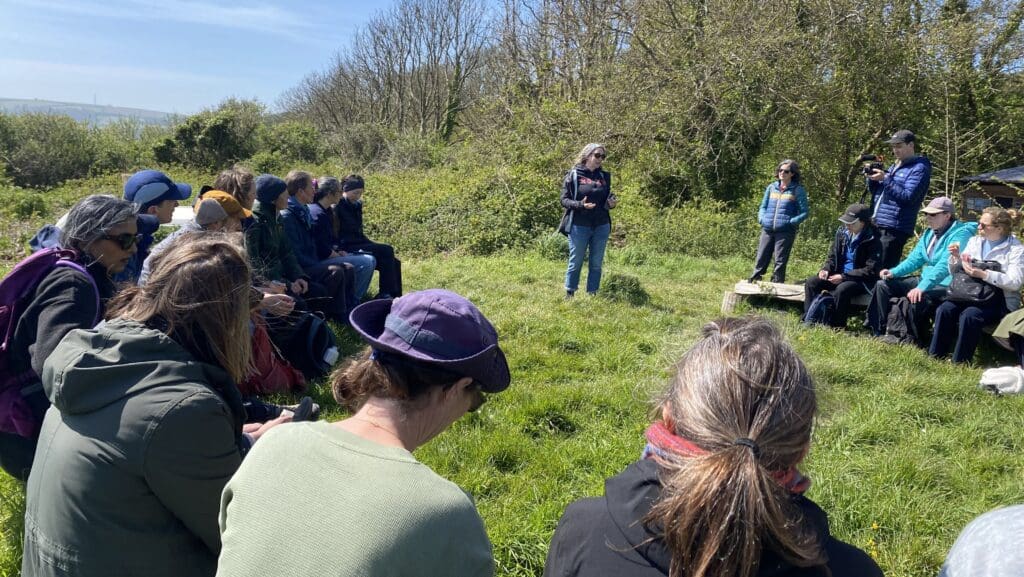
Pamela Buchan talking to the group about marine citizenship
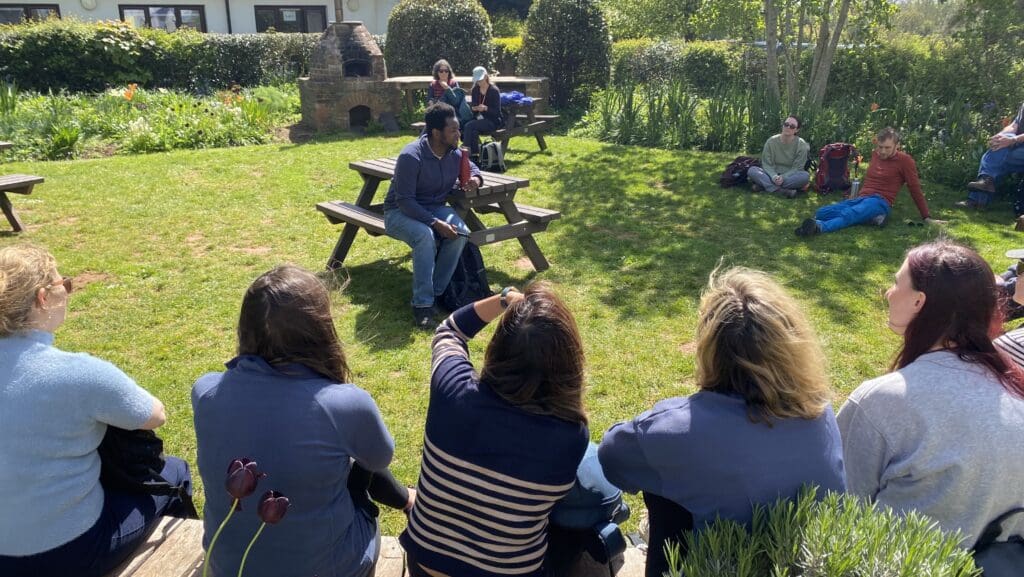
Andre Kpodonu sharing reflections from his recent work around organicism and fascism
Next up was the Apricot Centre Wellbeing Service (CIC) where the extraordinary enthusiasm of Rachel Phillips shone through. Ten years ago, with only £20k, the Apricot Centre was born on the back of a long lease from the Biodynamic Land Trust and to see what has been achieved in such a short time was slightly mind-blowing. We saw agroforestry used to prevent soil erosion (as well as elderflower), polytunnels producing all manner of fruit and veg, a therapeutic space used by veterans and children, and saw some pigs as the Centre gradually dipping their toes deeper into livestock. But that barely scratches the surface as they have well-being, education, consultancy offers too.
That night, we had a wonderful celebratory evening eating at the Riverford Field Kitchen, but prefaced with a talk from Rob Haward on its history and moreover its future.
We finished the next morning with some reflective sessions down at the Glade, a beautiful space down in Dartington.
What a few days – refreshing, exhausting, stimulating. Thanks all 😊

Helen Roberts, Socio-meteorologist at the MetOffice, writes about her particular highlights from the final retreat:
Nature connection is crucial for climate change mitigation and adaptation, so what better way to learn that to learn in nature.
I’ve just come back from the last of four residentials at Dartington Trust as part of the ACCESS cohort of Leadership Fellows. I can’t explain how instrumental this opportunity has been, suffice to say I have learned, grown, gained experience, insight, knowledge, perspectives, networks and friends along the way.
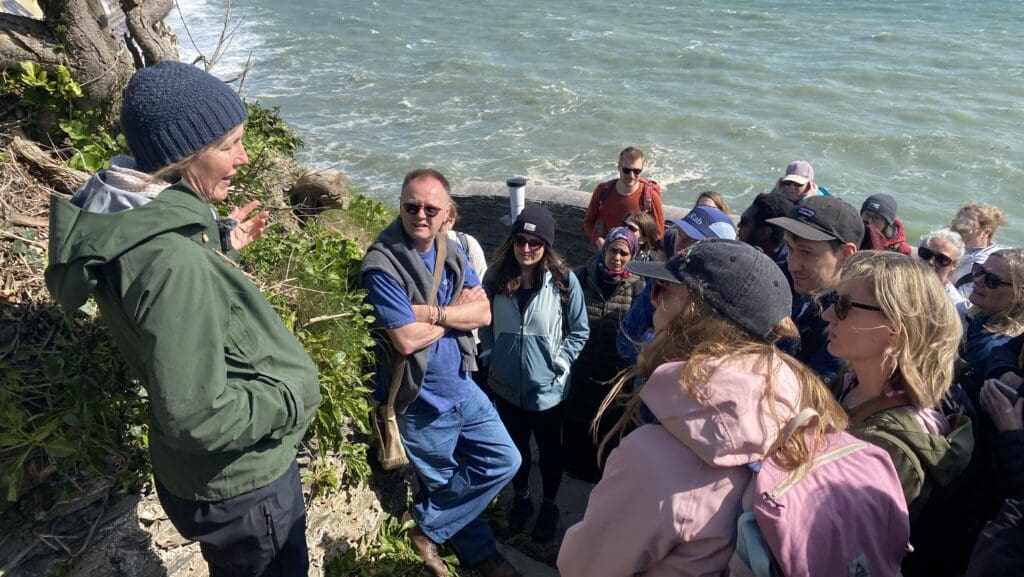
Gail Stubbs, owner of the Start Bay Inn, describing her experience of living and running a business in Torcross
This last retreat was special in so many ways. We certainly packed a lot in, and explored the surrounding area. This included talks by the wonderful Gail Stubbs, owner of Start Bay Inn, Sophie Day, coastal adaptation specialist, and Andre Kpodonu, director of Seeding Reparations. The walk from Torcross to Slapton Ley Field Centre was particularly poignant, being just a few hours after a flood warning for this particularly vulnerable population.
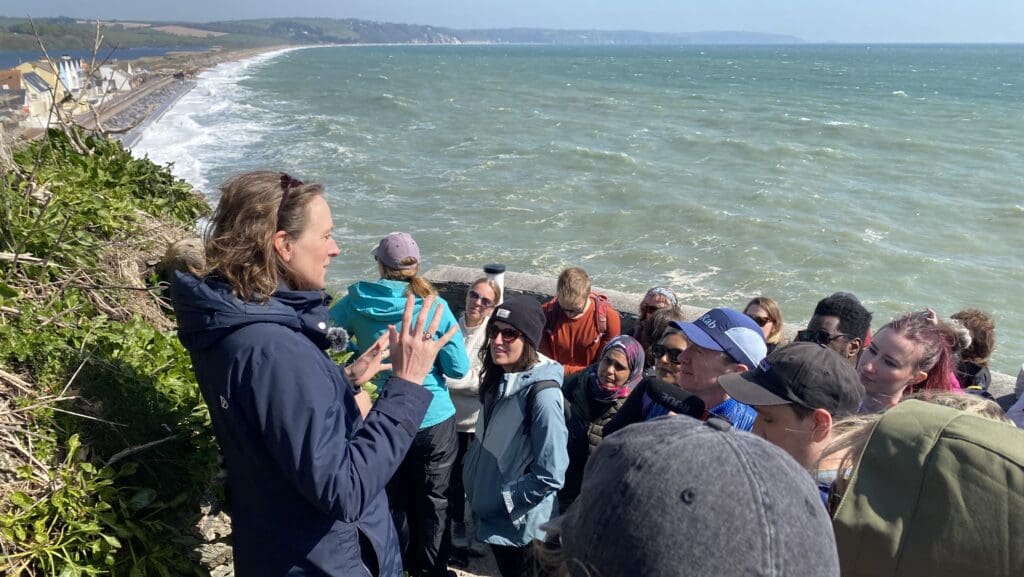
Sophie Day describing her work on the Coastwise Project in Norfolk
Following this, we visited the Apricot Centre and were treated to a tour of this amazing enterprise by CEO Rachel Phillips, who talked about her passion for regenerative agriculture, education and mental health on farms.
Then a perfect end to the day with dinner at Riverford Field Kitchen hosted by Riverford director Rob Haward, who talked about the company history, ethos and organisational structure before the MOST delicious food!
As if all that wasn’t enough, we were also treated to keynote from the fabulous Najma Mohamed, head of nature based solutions, UNEP-WCMC, who introduced us to the concept of Ubuntu, something I will carry with me throughout my career. As well as a heartfelt session on the connections between neurodiversity and environmental justice from Jennifer Rudd, Sarah E. Golding and Sarah Bell. All rounded off by the brilliant Susann Power who encouraged us to reflect on on our leadership skills, and by drawing on four years of the ACCESS Leadership College we each set one key BHAG: ‘Big Hairy Audacious Goal’.
I can’t thank the ACCESS leaders, staff and fellows enough, as well as ESRC (Economic and Social Research Council) for taking a chance on funding this innovative project.
Susann Power, Senior Lecturer at Ulster University, writes about the evening at Riverford Field Kitchen and CEO Rob Haward’s inspiring keynote:
I had the enormous pleasure of eating at the Riverford Organic Farmers Field Kitchen tonight and listening to CEO Rob Haward tell the story of food systems, resilience, organic farming, ethical business, entrepreneurship and B-Corp certification.
I have been researching ethical and environmental entrepreneurship for years, and seeing it in action + a feast of vegetables was an intellectual and culinary highlight. Thank you to ACCESS for making it possible!
In a post about the Leadership College on her blog, Susann also writes:
I have just returned from the final ACCESS Leadership College retreat. We said our goodbyes, exchanged numbers, and promised to stay in touch. I hope we will, and early signs are promising, with collaborative projects already emerging. More than anything, I feel privileged to have participated in such a thoughtful, humane, and genuinely transformative professional development experience.
The Leadership College model is something I hope to replicate in my own practice whenever the opportunity arises. It is a reminder that leadership does not have to be rushed, competitive, or extractive. Sometimes, the most powerful thing we can do is slow down, learn together, and place people at the heart of climate action.
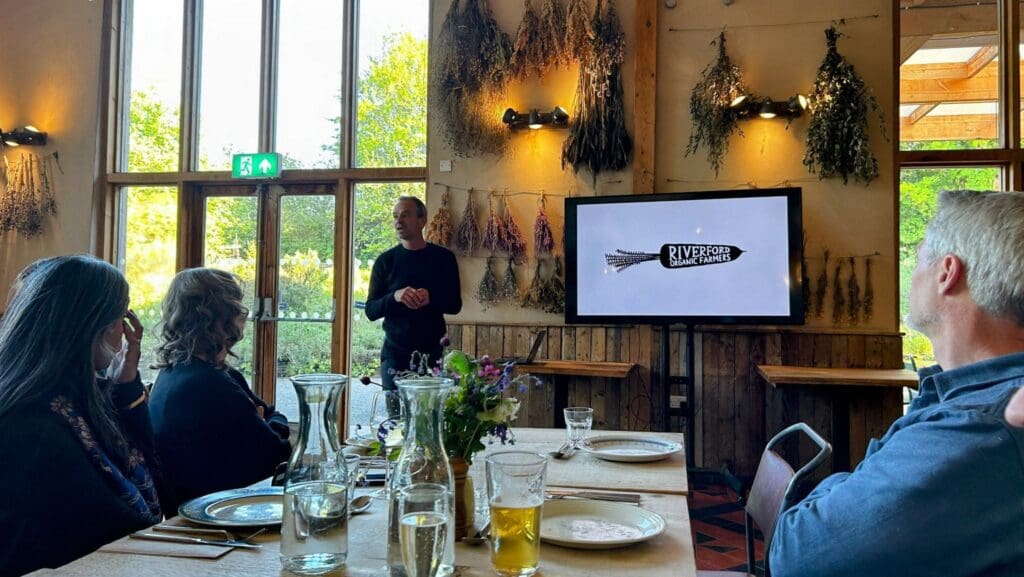
Rob Haward’s keynote at Riverford Field Kitchen
Lastly, Jennifer Rudd , Senior Lecturer at Swansea University, describes what her experience of being a Leadership College Fellow has given her:
It’s the last ever ACCESS Leadership College retreat at Dartington this week. It’s made me reflect on what’s happened over the past four years, who I was, who I am, who I want to be.
Four years ago I arrived early for the first retreat. I’d recently been diagnosed autistic, recently got my first permanent lectureship position, didn’t feel like a social scientist at all and had no idea what “Environmental Social Science” was. I was intimidated by everyone, knew I would need to make friends but didn’t know how, had to learn my way around and every talk felt like it was way over my head and I didn’t understand it and had no idea how to implement it!
Fast forward four years. I’m back, I’m confident, I know everyone (some are even my friends), I’ve got a much broader understanding of environmental social science and I’m much more at home calling myself a social scientist.
Between the first and last retreats I’ve formed international collaborations, advised Welsh Government on net zero, incorporated the things I’ve learnt at Dartington into my teaching, completely revised assessments for my modules, won funding, started a new area of research, led research teams, worked on projects with colleagues from the USA and from Nigeria.
Where will I be another four years from now? I’ve got some ideas!
So what has ACCESS given me and how much would I have done anyway? No idea! ACCESS has made the most direct impact on my teaching and has led to some very enjoyable seminars for my students. Directly, with additional input from me, it’s given me a friendship group and a possible follow-on project. It’s also provided an opportunity to understand Environmental Social Science as a concept and as something to advocate for. Indirectly it’s given me external perspective on my current role, and I’ve learnt from people in civil service and third sector jobs so I’ve been able to assess where my skills could take me should academia no longer fit.
I’m going to miss this week in April where I get together with people and think about fixing the world.”
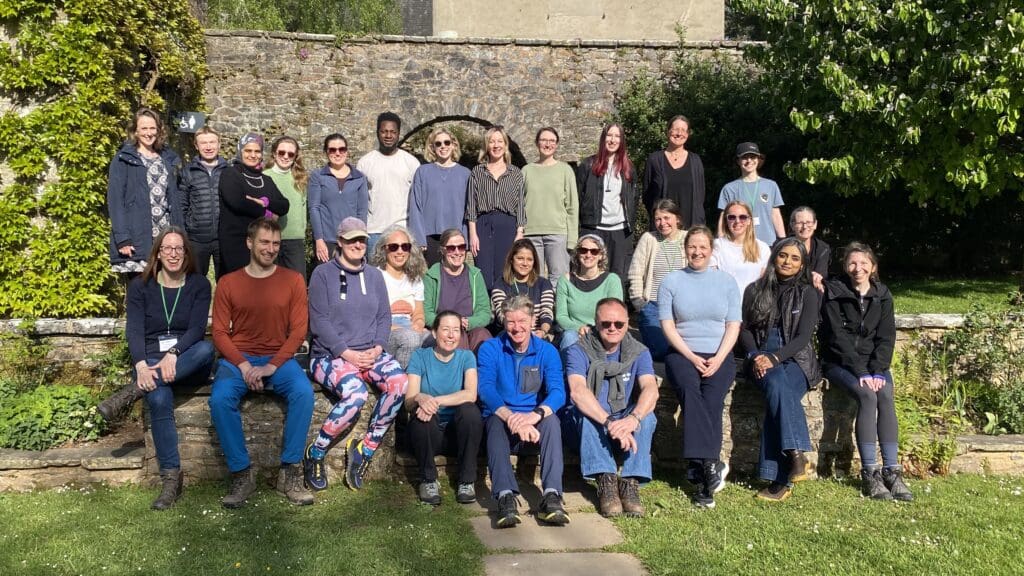
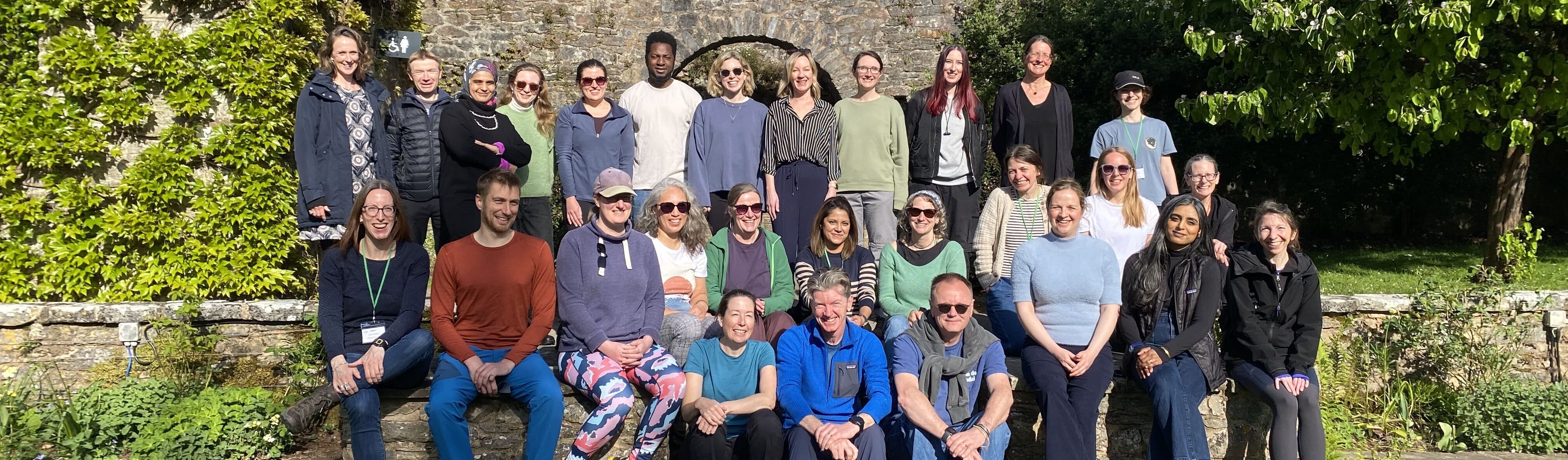
Leadership College Fellows, speakers and ACCESS team pose for the final obligatory group photo