Unlocking the Power of Youth to develop equity in net-zero governance

Kaya Axelsson
Head of Policy and Partnerships Oxford Net Zero
University of Oxford

Matilda Becker
Strategic Partnerships Manager Oxford Net Zero
University of Oxford

Alexis McGivern
Head of Stakeholder Engagement Oxford Net Zero
University of Oxford

Tom Maitland
Oxford Net Zero Youth Advisory Board
The Project
This project ran from October 2024 to October 2025.
In partnership with the British Standards Institution, it aimed to bring youth climate justice representatives across six continents into international standard-setting processes to develop equity criteria for net zero governance. These criteria were produced with UK-Plc to address the governance gap that fails to define how companies can address equity concerns when they decarbonise their footprints.
This project responded to a long-established yet engrained issue of how groups at different geographical scales and with differentiating power can engage in policy- and decision-making to address environmental challenges. The project therefore aimed to:
- develop novel methods for bringing global youth’s expertise into climate governance
- demonstrate how youth and marginalised voices can be included in governance processes more broadly
We are so grateful for the support of the ACCESS fund! We learned so much throughout this process and really appreciated being able to try something completely new and experimental. We really enjoyed working with the ACCESS Team, and felt supported by the ACCESS Team throughout. It was a special and unique opportunity to be part of a bigger network of other ACCESS projects, and we particularly valued the opportunity of attending the ACCESS Assembly.
We look forward to building on this work and staying in touch as it grows!
Matilda Becker, Oxford Net Zero, University of Oxford
Methodology
The project had three objectives:
- demonstrating the use-case for co-created youth inputs into net-zero standards, as a methodological model to improve procedural justice for other marginalised groups
- filling the equity-gap in net-zero guidance by embedding co-created, reward-oriented equity criteria to incentivise UK-Plc investment in global, systems-wide community-based projects
- improving the legitimacy and global applicability of net-zero guidance through the integration of non-European and non-hegemonic knowledges and priorities into the governance landscape
Our work aimed to advance the uptake of social science methodologies by:
- developing international citizens’ assemblies literature by convening twelve youth across six continents. We employed participant selection criteria that centred accessibility and diversity, and allowed the focus of workshops to be participant-led
- engaging with methodologies that explored the challenges of bringing together actors in cross-sector, multi-stakeholder partnerships to effect systemic change. By placing the primacy of power on the youth coalition, and developing our and the BSI’s established trust-based relationships with corporates and standards bodies, we aimed to demonstrate practical approaches for meaningfully bringing disparate groups together in a manner that recognised and directly addressed power imbalances between groups.
By considering procedural equity in net-zero standard-making, our project sought to develop a new form of legitimacy and social licence by building on broad and deep engagement across demographics, geographies and practice. The project tested new methods for global consensus-building, providing a blueprint for future engagements by standards bodies and other social-science researchers.
We convened youth and UK-Plc both online and in-person in the UK and at the Bonn Climate Change Conference in June 2025.
Guiding Principles
Our network aspired to convene youth, businesses and standards communities on equal footing. Participation was structured to allow youth to guide the narrative of conversation, shifting the balance of power towards a group that traditionally experiences a high-barrier of entry in affecting change in the climate governance space.
Knowledge co-production undergirded all phases of our research and provided the motivating ontological framework. Being youth-led, and taking place over a series of 9+ workshops, our methods were deliberately reflexive and iterative, creating opportunity for existing assumptions to be put at risk, and shared conceptualisations to be built with learnings for all stakeholders.
Our environmental sustainability approach was structured around ensuring the net-zero governance landscape can better deliver on scrutinising pledges and promises. The actual workshops were convened online, and any in-person gatherings were to be accessible by public transport.
Outcomes
OXFORD NET ZERO YOUTH ADVISORY BOARD
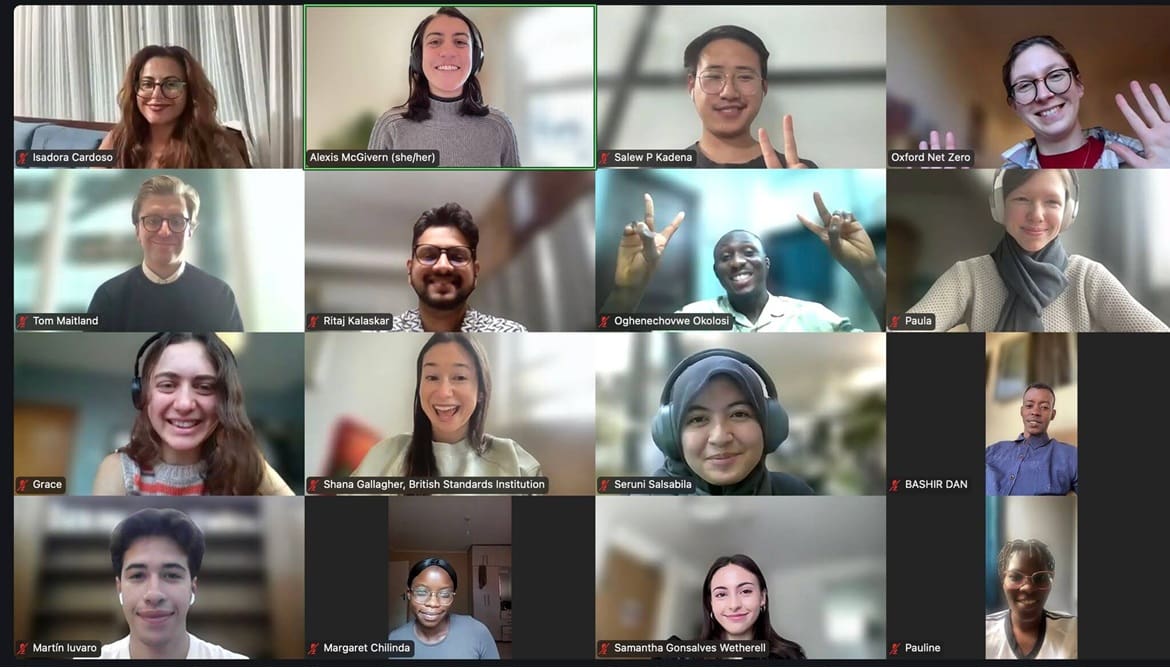
The Youth Advisory Board comprises 12 members spanning 11 countries. The project placed co-production and youth agency at the centre of a space typically dominated by technical/standards language.
Through backcasting and collaborative drafting, the Youth Advisory Board translated social-science concepts like climate justice, governance, power; redistribution of resources and decision-making; nature-positive economies; and Indigenous stewardship, into standards-facing equity criteria.
ENTERPRISE BRIEF
“Making corporate climate transitions work: business guidance for implementing just and equitable transition plans”
Developed by the Youth Advisory Board, this brief outlines how companies can integrate justice and equity into their climate strategies to ensure a just transition that supports long-term, socially sustainable net zero goals. It presents a seven-step roadmap to help businesses identify and engage with groups affected by transition plans, co-create fair outcomes, and strengthen resilience. It emphasises procedural justice and highlights how a just transition risk can reduce risks, unlock opportunities, and build public support for climate action.

JOINT RESPONSE TO SCIENCE BASED TARGETS INITIATIVE
The team influenced the drafting of the first internal iteration of the ISO Net Zero Standard by informing technical working group members of how equity and justice could be threaded into the new Standard. Their self-organising and collaboration were demonstrated in their joint submission to the Science Based Targets Initiative (SBTi) public consultation on the Corporate Net-Zero Standard in May 2025.
AWARD
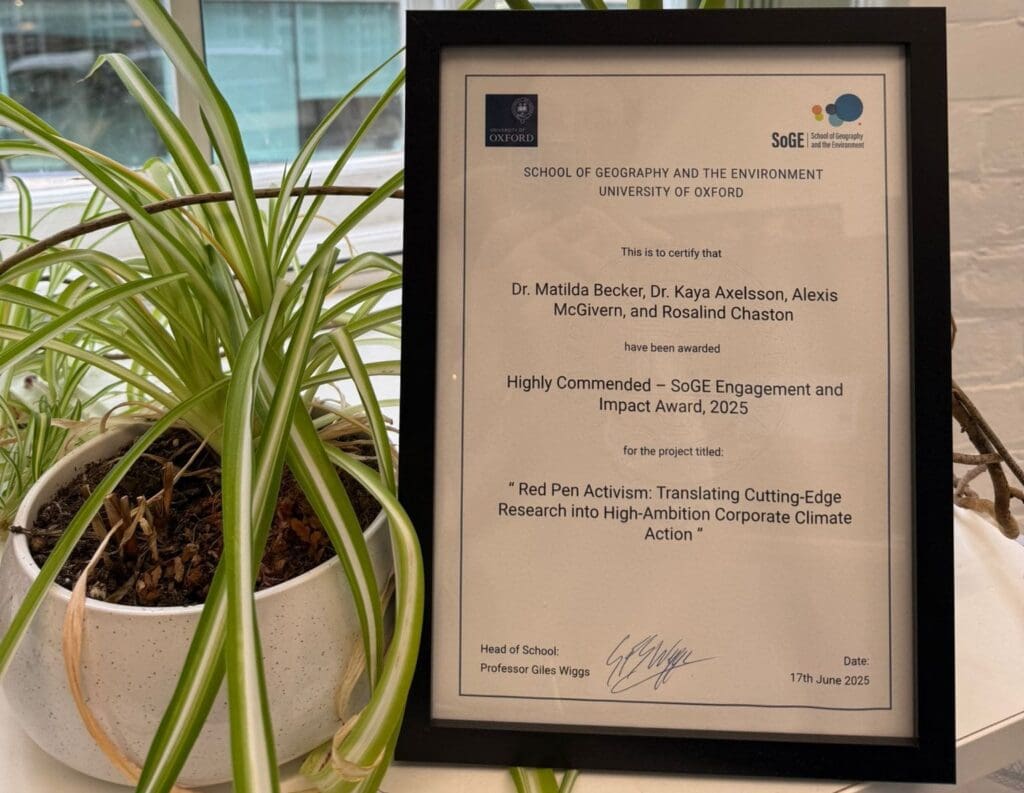
The project team was awarded the ‘Highly Commended – Engagement and Impact Award, 2025’ for their work on net zero standards and advocacy for just transitions by the School of Geography and Environment at the University of Oxford.
Impact
YOUTH ADVISORY BOARD NETWORK
The Youth Advisory Board has now become a network, and functions as a peer community that exchanges ideas and opportunities, particularly related to this intersection of just transition and net zero standard. The project team has also strengthened the University of Oxford’s ties with the cohort, encouraging cross-pollination through mentoring, supporting applications for postgraduate study at the University, and staying closely connected on related professional projects.
CHAMPIONING ENVIRONMENTAL SOCIAL SCIENCE
The project worked to build skills for their Youth Advisory Board through real, applied, standards-facing work. Once the cohort were sufficiently comfortable with the technical language, the team worked to support them to translate their ideas into equity criteria usable to standards bodies. The approach yielded concrete capacity gains. Four cohort members now serve in technical roles, on National Standards Bodies, national ISO technical committees, and Science Based Targets Expert Working Group. This will allow them to embed their skills inside ongoing processes through 2026.
NEW CONNECTIONS
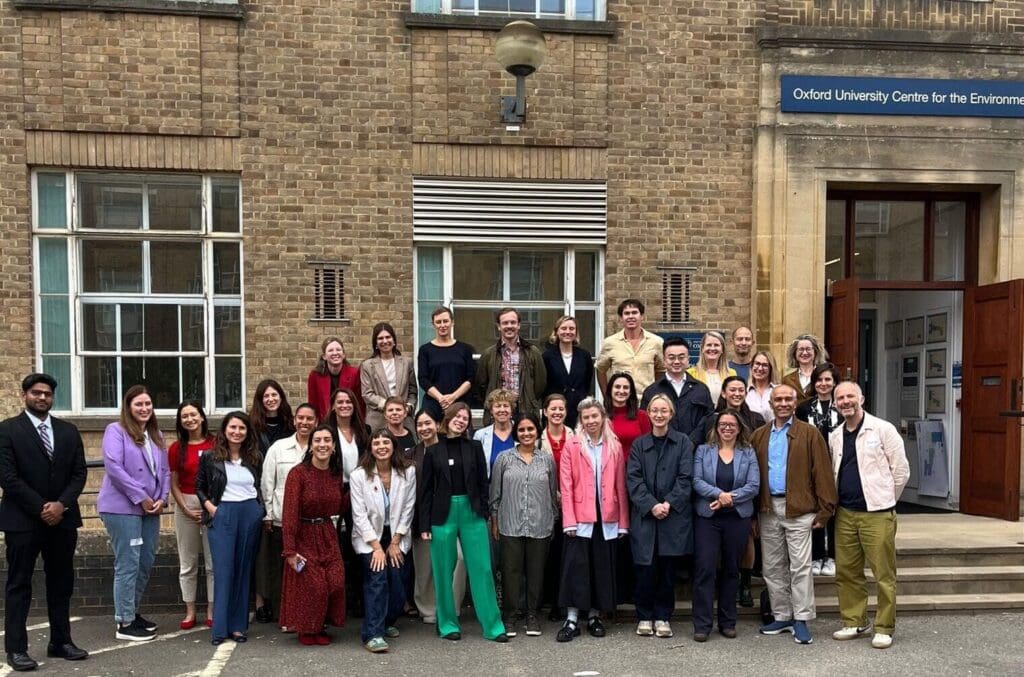
Alongside the youth network, the team has built a broader ecosystem of organisations, think tanks, and orchestration campaigns focused on the just transition (e.g., the Race to Zero, the World Benchmarking Alliance). To align strategies and amplify impact, the project members convened 15 representatives from standards organisations in person in Oxford in mid-September for joint planning ahead of the next round of standards updates in autumn 2025. This work ensures the Youth Advisory Board’s equity criteria are championed by multiple organisations, increasing the likelihood that they inform forthcoming revisions and corporate implementation. Together, these new networks we hope will provide durable channels for knowledge exchange, shared advocacy, and practical uptake of equity-centred net-zero guidance.
Future Plans
NEW PROJECT
The IKEA Foundation has asked the project team to conduct further research into the governance of the net zero standards ecosystem, to identify what can be learned from product standards such as FairTrade about good governance, particularly procedural justice, and its effect on standard effectiveness. This next phase of work will translate lessons into practical reforms across the net-zero standards ecosystem.
ACADEMIC PAPER
An academic paper is undergoing final revisions prior to submission to GeoForum, entitled “Standards of Care: the role of net zero standards in setting just-transition ground rules for corporates’ climate action plans”.